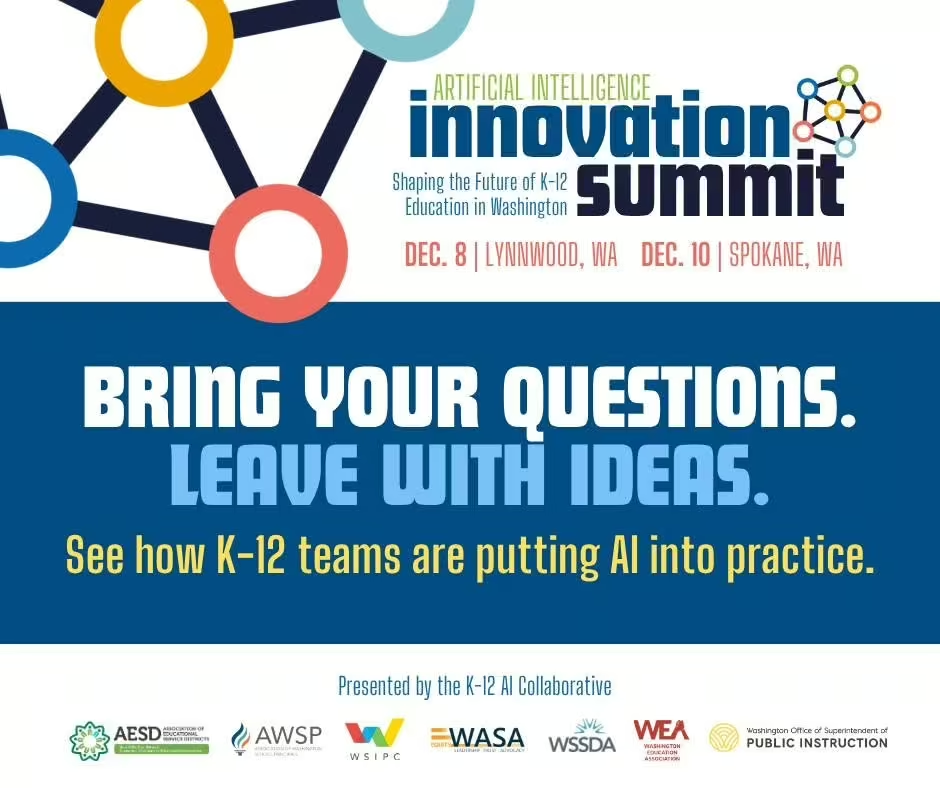
Registration is now open for the 2026 AI Innovation Summit! Join educators and education leaders from across Washington to share ideas and explore practical applications of AI in K–12 education. Hosted by the K–12 AI Collaborative, the Summit brings together a partnership of statewide education associations, including AESD and Washington’s nine ESDs.
Whether you are exploring AI for the first time or leading district-wide implementation, the Summit offers practical, role-relevant learning, statewide guidance, trusted resources, and peer connections to support your work long after the event ends.
Summit Locations & Details
Both Summits offer the same program and learning opportunities. Educators can attend the location that works best for them, with options on either side of the state.
West Side Summit: Tuesday, December 8 | Lynnwood Event Center
East Side Summit: Thursday, December 10 | Spokane Convention Center
Schedule: 7:30 a.m. registration | 8:00 a.m. – 3:30 p.m. program
Cost: $125 per educator (includes lunch and clock hours)
Group rate option for 10+ team members: Want to bring a larger team to participate in the Summit experience together? We offer a discount starting with 10 team members, $100 per educator.
Register for the AI Innovation Summit
NWESD Presents “Media Literacy & Washington’s New ELA Standards”
Learn from Washington educators, leaders, and experts shaping how AI is understood and applied in K–12 education. Connect with peers from across the region and bring practical ideas back to your school or district.
NWESD Instructional Technology Specialist Vanessa Allen and Regional Literacy Coordinator Dr. Kristine Nugent-Ohls will lead the Summit session “Media Literacy & Washington’s New ELA Standards.”
Washington’s new ELA standards introduce a dedicated Research and Media Literacy domain, positioning media literacy as a foundation for responsible AI use. Participants will work in role-alike groups to test the AI Decision Cycle and leave with a ready-to-share toolkit.
More Opportunities to Learn
Extend your professional learning beyond the Summit with online courses.
Explore three media literacy learning opportunities offered in partnership with OSPI:
- Media Literacy & Digital Citizenship Resources: Grades K–5 (Fall 2026–27) (4 Clock Hours)
Discover practical tools for teaching foundational digital citizenship and media evaluation skills in elementary classrooms.
- Media Literacy & Digital Citizenship Resources: Grades 6–12 (Fall 2026–27) (16 Clock Hours)
Help secondary students develop critical media analysis skills and strategies for navigating digital spaces ethically.
- Media Literacy Inquiry-Based Teaching Strategy (Fall 2026–27) (8 Clock Hours)
Explore inquiry-driven teaching methods that help students evaluate information critically across subjects.
Looking for introductory AI training? Enroll in AI Basics for Educators – Cohort 5 (7 Clock Hours)
- Build foundational AI literacy, explore practical classroom tools, and learn ethical guidelines for everyday educational use.
We also offer two book studies featuring books on AI.
- Book Study: Teaching with AI (15 Clock Hours)
This fully asynchronous course is a book study of José Antonio Bowen and C. Edward Watson’s 2025 Second Edition book Teaching with AI: A Practical Guide to a New Era of Human Learning, a timely book that offers educators a useful guide for how to navigate the classroom in the age of AI. Bowen and Watson explain how AI works, offer practical advice on how to teach with AI and create educational policies for AI usage, and also examine how students can learn with AI. - Book Study: Verified (15 Clock Hours)
This fully asynchronous course is a book study of Mike Caulfield and Sam Wineburg’s 2023 book Verified: How to Think Straight, Get Duped Less, and Make Better Decisions About What to Believe Online. Caulfield and Wineburg explain how people make mistakes in reading online content and offer useful strategies for verifying information. The book offers educators a useful guide for helping students navigate online content and build their digital literacy skills, including with content produced by AI.